Architecture Overview
This project implements a two-phase web scraping pipeline using AWS Lambda functions written in Node.js, Go and Perl. The system is designed to handle dynamic, JavaScript-rendered pages and convert them into structured data.
High-Level Flow
This diagram is generated from YAML using awsdac.
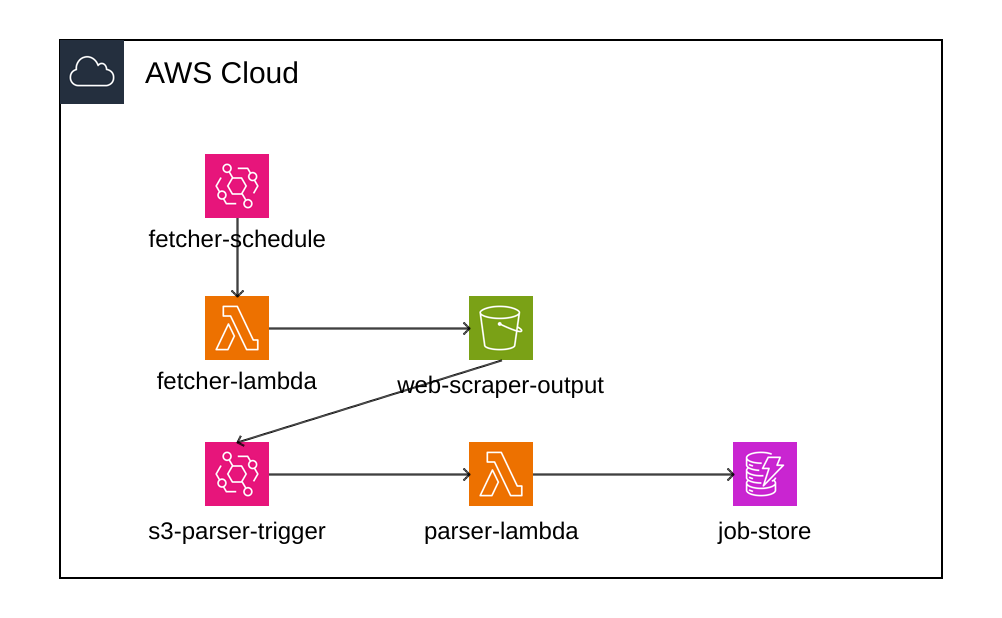
Components
-
fetcher-schedule
- An EventBridge rule that triggers the
fetcher-lambdaon a defined schedule (e.g., daily) - Allows full decoupling of the fetching cadence from other processing components
- An EventBridge rule that triggers the
-
fetcher-lambda
- A Node.js Lambda function responsible for fetching HTML content
- Uses headless Chromium (via Puppeteer) to render JavaScript-heavy pages
- Stores the fully rendered HTML in an intermediate S3 bucket
-
web-scraper-output
- Acts as a bridge between the fetch and parse phases
- Receives raw HTML from the fetcher
-
s3-parser-trigger
- An EventBridge rule that listens for
ObjectCreatedevents from theweb-scraper-outputS3 bucket - Allows for decoupled and scalable downstream processing
- An EventBridge rule that listens for
-
parser-lambda
- A Perl-based Lambda function and a Go Lambda function that parse the stored HTML
- The Perl function uses a custom runtime implemented via a
bootstrapscript and is deployed as a Docker container, while the Go function uses a zip-based deployment with theprovided.al2runtime - Parses HTML using
Mojo::DOM(Perl) orPuerkitoBio/goquery(Go) to extract structured job listings
-
job-store
- Stores structured job listings parsed by the Lambda functions
Infrastructure
- terraform-web-scraper
Terraform project for managing infrastructure: S3 buckets, Lambda deployment, IAM roles, and CI/CD wiring.